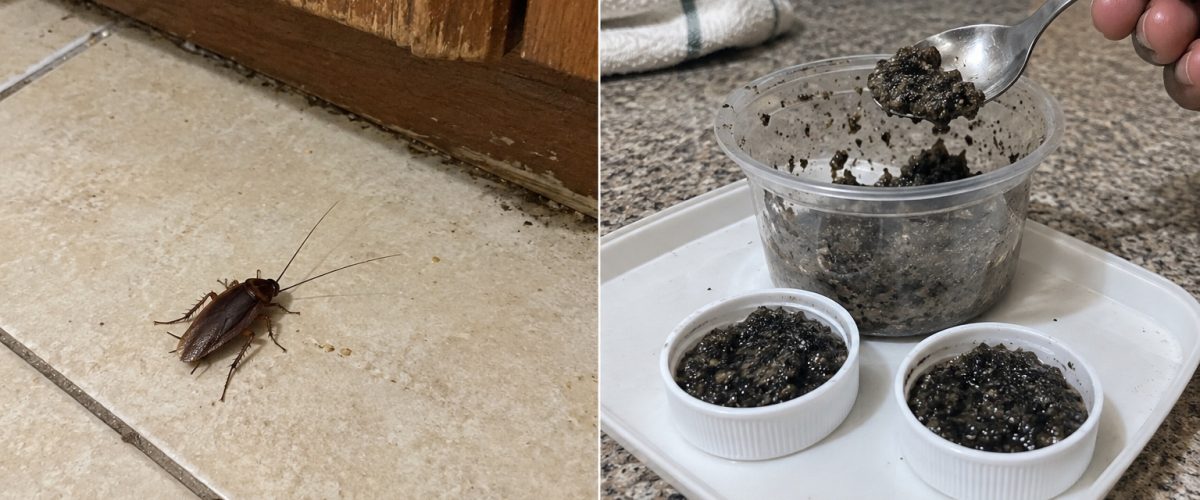
Seeing a cockroach disappear beneath the kitchen cupboard is enough to make you question every dark corner. You want something practical, affordable, and easy to place where the insects seem to travel. That is exactly why small homemade baits attract so much attention.
Take control of the problem by combining a closer look at pest activity with a thorough kitchen reset. If you are considering charcoal, sugar, baking soda, and water as a homemade bait, understand its limits before putting it anywhere near food: it has not been established as an effective cockroach treatment.
Know what your bait contains
The homemade mixture combines finely powdered charcoal, three teaspoons of sugar, two tablespoons of baking soda, and a small glass of water. Sugar provides a potential food attractant, while water changes the texture. A bottle cap can hold a small portion, but it does not make the contents inaccessible to children or animals.
Keep attraction and control separate in your planning. An insect eating a sugary paste has found food; it has not necessarily consumed an effective treatment. Neither the dark color of charcoal nor the familiar fizz of baking soda tells you that the mixture will clear hidden cockroaches.
Charcoal should not be confused with a proven insecticidal ingredient. Nor should barbecue ash, fuel briquettes, or material containing lighting additives be substituted into a household recipe. Keep homemade bait out of food-storage areas and do not use it as a replacement for established control. Avoid breathing fine charcoal dust or leaving loose material where it can spread onto kitchen surfaces.
A cockroach sighting is a clue
Start by writing down where you saw activity. Was the insect beside the sink, at a cabinet hinge, near a warm appliance, or in a bathroom corner? Repeated sightings in one area can help focus an inspection, while a single sighting does not tell you how many insects are present.
Check accessible edges and gaps without dismantling electrical appliances or moving heavy equipment alone. A torch and a short location list are more useful than placing ingredients randomly throughout the house. Photograph an insect if you can do so easily; identification matters when choosing control methods.
Remove the food already on offer
Before adding any bait product, look for the accidental meals already available. Crumbs under a toaster, residue around a bin lid, forgotten pet food, and spills inside a cupboard can keep a kitchen attractive to pests.
- Put open dry foods into securely closed containers.
- Clean ordinary food spills and greasy residue from accessible surfaces.
- Empty rubbish regularly and keep the bin lid closed.
- Check for leaks or standing water around the sink.
- Reduce unnecessary cardboard and clutter that make inspection difficult.
These steps are useful even when professional treatment is needed. They also make it easier to see whether new signs of activity are appearing, instead of confusing yesterday’s mess with something that happened overnight.
Choose a bait with clear directions
A commercially formulated cockroach bait identifies its intended pest, active ingredient, and application instructions. A labeled bait station or gel provides more information than a homemade mixture whose quantities and effectiveness are uncertain. Choose a product suitable for the location and follow its label.
Placement matters, but more is not automatically better. Keep products away from food, utensils, and places accessible to children or animals. Do not empty a bait station into bottle caps or combine products in the hope of making something stronger.
Expect to monitor progress rather than assuming the kitchen will be clear tomorrow. Established infestations can need repeated attention, and the appropriate timing depends on the treatment. If you are unsure what to use, a pest-control professional can assess the situation.
Keep mice out of the cockroach promise
Treat mouse activity as a separate problem. Rodents and cockroaches need different control methods, even when you see signs of both in the kitchen. Do not assume a cockroach bait will deal with a mouse, or leave additional sugary food around in the hope that it will.
Gnawed packaging, rodent droppings, or repeated mouse sightings call for a separate assessment of entry points and suitable trapping or professional control. Keep suspected contaminated areas away from food preparation, and use appropriate rodent-cleanup guidance rather than treating droppings as ordinary crumbs.
Measure results instead of guessing
A simple record can make a big difference. Note the location, date, and number of sightings. If you use monitoring traps, place and check them according to their instructions and keep the locations consistent enough to compare observations.
One quiet evening does not prove that a colony has disappeared. Likewise, seeing a cockroach approach a sugary mixture shows attraction, not successful control. Missing bait is not proof of a kill. Look for sustained improvement, and keep checking the areas that first drew your attention.
Repeated daytime sightings, activity across several rooms, or a problem that continues despite your efforts are reasons to ask for professional help. In shared buildings, notify the responsible property manager so adjoining spaces can be considered.
Does this really work?
The charcoal, sugar, baking soda, and water recipe does not justify a promise that cockroaches or mice will disappear within days. A food attractant is not automatically an effective pest-control product. A more dependable plan combines removing accessible food and water, inspecting entry and hiding areas, using suitable labeled products, and monitoring the outcome. Give priority to a routine that helps you identify the pest, remove easy food sources, and judge whether activity is actually declining.


