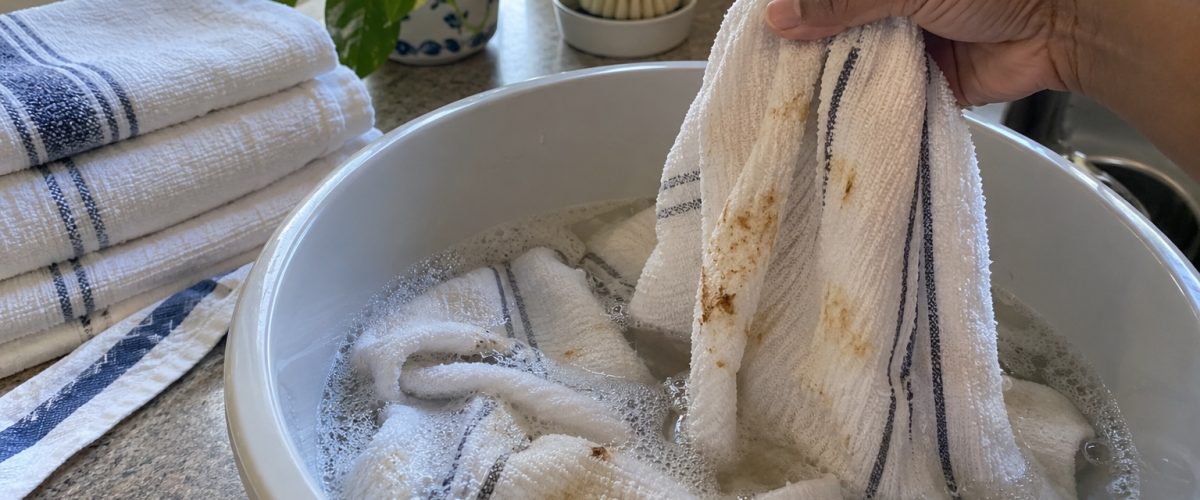
White kitchen towels can look tired long before the fabric wears out. Grease near the corners, brown cooking splashes, and a general gray cast make them seem ready for the rag pile. A careful soak can loosen some of that buildup and give the next wash a better chance.
Start with a simple principle: use a laundry product at its recommended dose, water at a temperature the fabric allows, and enough room for the towels to move. A basin packed with fabric and an oversized scoop of detergent usually creates more rinsing work, not a better result.
Check the towel before the water
Read the care label and separate plain white towels from colored, printed, or delicate ones. Even a mostly white towel may have a colored border that can bleed or fade. Check seams and worn areas before subjecting older fabric to another long soak.
Identify the stain as closely as you can. Grease, tomato sauce, coffee, and general detergent buildup do not behave identically. A stain that has been through a hot dryer may need more patience than a fresh splash caught immediately.
What you need for the soak
Gather a clean basin, water within the towel’s permitted temperature range, a laundry detergent that allows hand soaking, and household gloves if the product recommends them. Keep a separate space available for draining the fabric without splashing the floor.
Measure the detergent according to its directions for the amount of water you are using. Do not use a whole cup in one liter unless the product specifically calls for that dose. Powder formulations vary, so a universal scoop size is not a reliable recipe.
Leave salt and vinegar out of the detergent solution. They are not necessary for this starting method, and combining laundry additives without checking compatibility can interfere with the product or fabric care instructions. Never add vinegar to chlorine bleach.
Prepare and soak the towels
- Remove loose food. Shake or scrape away ordinary crumbs and solids before they end up floating in the basin.
- Pretreat a stubborn mark. If the detergent permits it, work a little of the recommended pretreatment into the stain. Follow its instructions rather than rubbing aggressively.
- Prepare the water. Use a stable basin and a safe temperature within the care label’s limit. Boiling water is unnecessary and introduces a scalding risk.
- Dissolve or disperse the detergent. Mix it as directed before adding the towels, so concentrated powder is not trapped against one patch of fabric.
- Submerge the towels loosely. Give the liquid room to circulate. Prepare a second batch if the basin is too full.
- Follow the soaking time. Use the product’s guidance rather than leaving the fabric indefinitely or assuming that cooling water marks the correct endpoint.
Keep the basin out of reach of children and animals. Do not add another cleaning product midway through because a stain is still visible. Drain carefully, and avoid lifting a heavy, dripping bundle in a way that spills water over your feet.
Let the wash finish the job
After soaking, wash the towels according to their care label. Use the correct machine dose and avoid overloading the drum. The wash needs movement and rinsing to carry away the loosened residue; soaking alone is not the complete cleaning process.
Check the towels before using a hot dryer. If a mark remains, consider another suitable stain-treatment step rather than immediately applying high heat. Dry thoroughly before folding or putting them back into a drawer.
For persistent discoloration on compatible fabric, an oxygen-based laundry product may be an option if both its label and the textile’s care instructions allow it. Use it as directed, not as an extra ingredient in an improvised chemical cocktail.
Why towels become dull again
A towel that repeatedly absorbs cooking oil will need different handling from one used only to dry clean dishes. Keep separate towels for hands, dishes, and messy food preparation so grease is not continually transferred between jobs.
Hang damp towels where air can reach them instead of leaving them bundled beside the sink. Replace a wet towel with a dry one when needed, and wash regularly. A clean smell is useful, but perfume should not be the test of whether a towel is clean.
Use less detergent if you have been exceeding the label dose. Persistent soap residue can make a towel feel stiff and complicate rinsing. Fabric softener can also be undesirable for absorbency, so check the towel manufacturer’s recommendations before adding it.
Know when to change its job
Some stains become permanent, and heavily worn fabric may never look bright white again. A sound towel with a cosmetic mark can still have a useful household role, while a torn or degraded one may be better retired from kitchen duties.
Does this really work?
A correctly prepared detergent soak can loosen some grease and food residue before washing, which may leave white towels looking brighter. It cannot guarantee the removal of every old stain or restore damaged fibers. Boiling water, excessive detergent, salt, and vinegar are not a universal whitening formula. Match the treatment to the fabric and stain, follow the laundry product’s instructions, rinse well, and judge the result after proper washing and drying.


