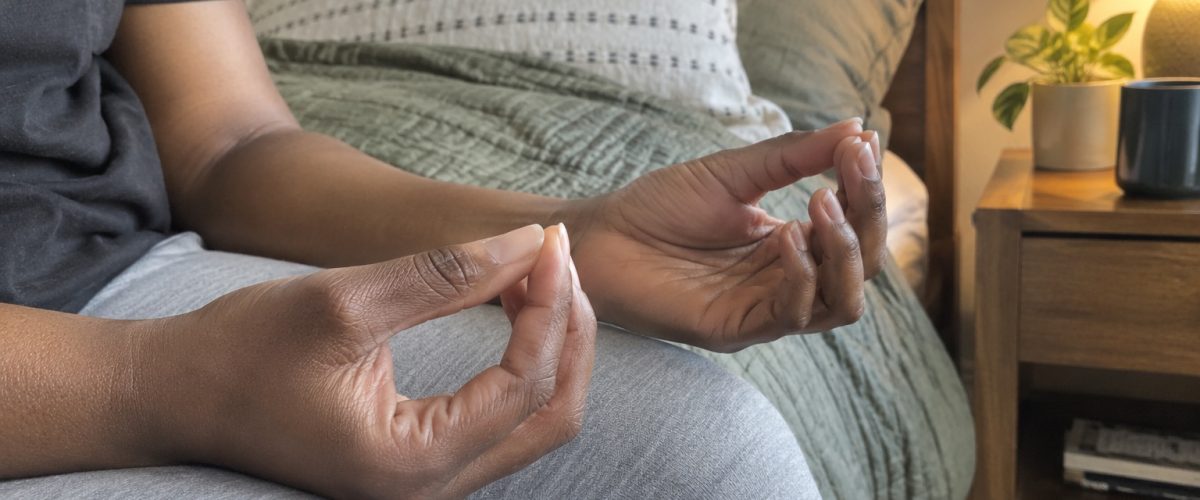
Your hands do not need another job at bedtime; they can become a small reminder that the day is slowing down. A few gentle movements give you something simple to focus on while you settle into a quieter evening. The routine below is an optional relaxation exercise, not a method for activating healing, correcting digestion, or guaranteeing sleep.
Keep it light and comfortable. There are no pressure points you must find, no forceful stretches, and no special ingredients. If your hands hurt, feel numb, or have an injury, skip movements that aggravate them and seek appropriate advice rather than pushing through.
Prepare the setting first
Sit in a supported position with your feet comfortably placed and your forearms resting on your lap or a cushion. Choose enough light to see what you are doing without keeping the room unnecessarily bright. Put the phone somewhere you will not keep reaching for it during the exercise.
Loosen any uncomfortable grip in your shoulders and jaw. You do not have to adopt a special posture or hold your back rigidly straight. The goal is a position you can maintain easily for a short time without balancing or bracing.
Begin with still hands
Place both hands on your lap and notice their contact with the fabric. Let the fingers rest in their natural shape. Take a few ordinary, unforced breaths without trying to fill the lungs as much as possible or hold your breath.
If your attention moves to tomorrow’s tasks, gently return it to the feeling of your hands resting. There is no need to empty your mind completely. The exercise can still be a quiet pause even if thoughts continue in the background.
Open and release gently
Slowly open the fingers a little, then allow them to return to a relaxed position. Repeat a few times at a pace that feels easy. Avoid making a tight fist or stretching the fingers to their limit.
Keep the wrists in a comfortable position and the forearms supported. If one hand moves less freely, do not force it to match the other. You can make the movement smaller or leave that hand resting while simply noticing the contact with your lap.
Try a light fingertip sequence
- Touch the thumb lightly to the index fingertip on one hand.
- Release, then touch the middle fingertip.
- Continue to the ring finger and little finger if comfortable.
- Let the whole hand rest before trying the other hand.
- Repeat only while the sequence feels easy and calming.
The touch should be light enough that you are not squeezing the fingertips together. There is no need to count perfectly or move quickly. This is a simple focus activity, not a coordination test or a measure of how well your body is functioning.
Add optional soft contact
If it feels pleasant, rest one palm over the back of the other hand for a moment, then switch. You can also make a few very light fingertip taps against your own palm. Keep the contact gentle and stop if the sensation is unpleasant.
Do not strike joints, press hard into tender areas, or use tapping to treat unexplained pain. There is no special force that activates a healing response. The useful part is a comfortable, repeatable pause with a clear beginning and end.
Finish before it becomes a task
Return both hands to your lap and sit quietly for a few ordinary breaths. Notice whether you are holding tension and let go where that feels natural. Then move on to the next simple part of your evening, such as putting away a book or settling the room.
You do not need a timer, but you can keep the practice brief. If counting movements makes you more alert or frustrated, skip the sequence and simply rest your hands. The routine should fit your evening rather than become another requirement you worry about completing.
Support the wider bedtime routine
A consistent sleep schedule, a comfortable room, and time to wind down can help prepare for sleep. Consider whether late caffeine, demanding work, or repeated phone checking is keeping the evening active. Change one manageable habit rather than rebuilding the entire night at once.
A hand exercise cannot cancel every sleep disruption. Noise, discomfort, stress, medicines, and sleep disorders may need separate attention. If poor sleep persists or affects daytime life, discuss it with a clinician instead of assuming you need a more elaborate movement sequence.
Avoid judging the routine by whether you fall asleep immediately afterward. A quiet activity can be worthwhile without producing a measurable result every night. If it does not suit you, choose another calm activity you enjoy.
Does this really work?
Gentle hand movements can provide a simple focus during a relaxing bedtime routine, and some people may find that pleasant. They have not been established as a way to activate healing, transform digestion, or cure insomnia. Keep the movements comfortable, avoid force and performance pressure, and treat persistent pain, numbness, or sleep problems as reasons for appropriate assessment rather than stronger tapping.


